Nursing Home Abuse

We have all heard stories about elderly patients being abused in nursing homes.  Unfortunately, it is a constant worry as many of us plan for our parents’ or loved ones’ future once they can no longer care for themselves at home.  Knowing the signs of nursing home abuse and contacting a lawyer who specializes in this area of the law are important steps in protecting your loved one.

The most obvious form of abuse is physical abuse.  Look for bruises, skin tears, or other signs of injury when you visit your loved one in a nursing home.

Emotional abuse is harder to identify.  Many elderly are affected by confusion and dementia but repeated complaints about shouting or threatening language, ridicule and humiliation, or blaming the resident for things that are beyond their control should be investigated.  Equally damaging, it is emotionally abusive if staff ignores the resident or the resident is placed in extended isolation.  Talk to your love one and talk to the staff, especially to the nursing supervisor or the resident’s physician, if you suspect this form of more subtle abuse.

Unfortunately, financial fraud and exploitation are also frequent forms of abuse in institutional settings.  A caregiver who is an abuser may use his or her position of authority and trust to extort money or to simply steal from a resident, or help themselves to the resident’s credit card. Needless to say, the resident should have very little cash with them in the nursing home and all credit cards should be left at home or sent home with a relative. Beware of any caregiver who signs documents on behalf of your loved one.

Finally, sexual abuse may be physical or non-physical.  It may be perpetrated by another visitor or by a caregiver.  Listen carefully, if your loved one is complaining about someone who is always in his or her room, and making inappropriate comments or advances.

Neglect and Poor Care Linked to Urinary Tract Infections in Nursing Homes

Urinary Tract Infections, or UTIs, are a common complaint among families with a mom or dad in long-term care.  UTIs can be dangerous.  First, UTIs can become a serious infection if untreated.  However, UTIs also lead to falls, because UTIs cause people to feel as if they have to go to the bathroom constantly – a problem when someone with dementia forgets to ask for help to go to the bathroom.  This problem is made worse by the fact that UTIs can also cause people who have no cognitive problems to exhibit signs of dementia, like having hallucinations.

Aggravating the diagnoses of a UTI is the fact that a recent study has linked UTIs in New Jersey nursing homes to a failure to administer medications and poor supervision.  A recent study written about in McKnight’s, a long-term care publication, reported the findings published in Geriatrics. You can read the full article here.

The study, conducted by the University of Colorado College of Nursing, confirms what many of us practicing in this field know – that UTIs may be evidence of poor care and neglect.  UTIs are many times caused by improper cleaning after toileting and being left in a diaper for too long.

If a loved one is experiencing recurrent UTIs, demand a care planning meeting.  Find out why the UTIs are happening and what is being done to prevent them. If you or a loved one are dealing with issues due to poor care, contact Stark & Stark today for your free consultation.

Nursing Home Guilty of Abuse Pushes to Change Rules Limit Legal Exposure

Many times, in the world of nursing home litigation and medical malpractice, you hear things like “caps on damages,” “tort reform,” of “medical review panels.”  These measures are presented as ways to “Stop the crisis!” or “Reign in out of control juries!”  The reality is, there is no crisis, juries are reasonable, and these measures are usually promulgated by nursing home companies solely to avoid liability.

A recent article from WFPL in Louisville, KY, recounts the story of Hazard Health and Rehab Center.  Within the walls of that facility, among other issues, two residents sexually abused a 91 year-old resident and another resident suffered a “gaping pressure ulcer.”  For the sex abuse, the facility paid a fine of $20,000, and for both incidents the facility was sued in civil court.

The nursing home industry in that state backed by among others state Republicans and the Kentucky Chamber of Commerce, want to make-up a law that will require a board of three “healthcare providers” that screen cases for merit – before a plaintiff can even file a lawsuit. This is designed to be yet another hurdle to achieving timely justice.   Helping to bankroll this idea?  Hazard Health and Rehab.

The article goes on to state that it’s the poor state of health care in KY is what’s causing the legal problems, not the law.  According to the article KY has more below average nursing homes than all but 8 other states.  “That just shows there’s widespread abuse, neglect, mistreatment of residents occurring in far too many nursing homes,” said Brian Lee, executive director of Families for Better Care.

You can read the full article here.

Be cautious whenever you hear of measures that limit a person’s ability to hold anyone person or company accountable in court.  There’s usually a lot of money behind the idea, and very little consideration for the good of the population. If you have any questions about a Nursing Home situation, contact Stark & Stark today.


Rating the Nursing Homes in New Jersey and Pennsylvania

The official U.S. government website for Medicare provides a tool that allows consumers to compare information about nursing homes. It is called Nursing Home Compare, and contains quality-of-care information on every Medicare- and Medicaid-certified nursing home in New Jersey and Pennsylvania.

The tool creates that information based on the “skilled” care that nursing homes provide, which is care given when you need skilled nursing or rehabilitation staff to manage, observe, or evaluate your health status. For example, skilled care includes intravenous injections and physical therapy.

The “Overall 5-Star” Rating System

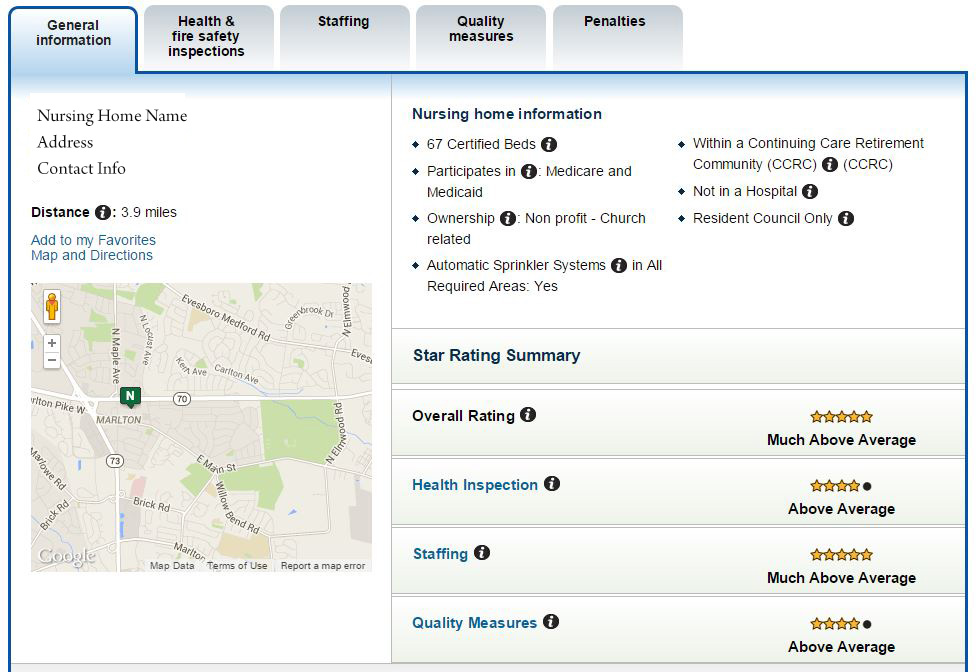
To rate the nursing homes, the tool uses an “Overall 5-Star” rating system. It assigns 1 to 5 stars, with more stars indicating better quality, across three “domains.” Those domains include: (1) Health Inspections, (2) Quality Measures, and (3) Staffing. The tool reports the ratings in table or profile form. Here is example of a nursing-home profile:

The Domains

The tool generates the rating for the  Health Inspection Domain based health-inspection ratings from the three most recent annual-comprehensive inspections, and inspections instigated in response to complaints in the last three years. It places more emphasis on recent inspections.

It generates the rating for Quality Measures Domain by combining the values on 9 out of 19 Quality Measures. Some of those measures include, for example:

  • the percentage of long-stay high-risk residents with pressure ulcers;
  • the percentage of long-stay residents experiencing a fall with major injury; and
  • the percentage of long-stay residents who self-report moderate to severe pain.

The tool derives those values from clinical data that nursing homes regularly report on a form called the Minimum Data Set.

And finally, the tool generates the rating for the Staffing Domain based on (1) the Registered Nurse (RN) hours per resident day, and (2) the “total staffing” hours per resident day. Total staffing includes: RNs, Licensed Practical Nurses, Licensed Vocational Nurses, and Certified Nurse Assistants. Nursing homes report staffing hours, which are from a two-week period just before the state agency conducts an inspection, to the New Jersey or Pennsylvania state-inspection agency. The agencies, in turn, report those data on Nursing Home Compare.

At Stark & Stark, our nursing-home negligence lawyers dedicate their entire practice to prosecuting nursing-home negligence lawsuits. We highly recommend the Nursing Home Compare tool when trying to assess a nursing home’s quality.

Blog Categories